Transmission Control Protocol
8. TCP: The Backbone of Reliable Internet Communication (And Why It’s Not Going Anywhere)
🎯 Challenge 1: The Reliability Puzzle
Imagine this scenario: You're downloading a 100 MB file. The internet is made up of millions of routers, switches, and cables - any of which could drop, corrupt, or delay your data packets. Yet somehow, your file arrives perfectly intact, every single byte in the correct order.
Pause and think: What mechanism ensures this reliability when the underlying IP protocol is "best-effort" and unreliable?
The Answer: TCP (Transmission Control Protocol) acts as the internet's trusted courier service. While IP just tosses packets into the network hoping they arrive, TCP guarantees:
- Reliable delivery - Every packet arrives or gets resent
- Correct order - Packets arrive in sequence, even if they traveled different routes
- Error-free data - Corrupted packets are detected and retransmitted
Key insight: TCP transforms unreliable IP into a reliable communication channel!
🤝 Interactive Exercise: The Coffee Shop Conversation
Scenario: Imagine you want to start a conversation with someone at a coffee shop. What's the natural flow?
Think about the steps:
- You make eye contact and wave (signal your interest)
- They wave back (acknowledge they're interested)
- You walk over and say "Hi!" (confirm you're starting the conversation)
- Now you can talk!
Question: Why don't you just start talking from across the room?
TCP's 3-Way Handshake: The Digital Version
TCP does exactly this before sending data:
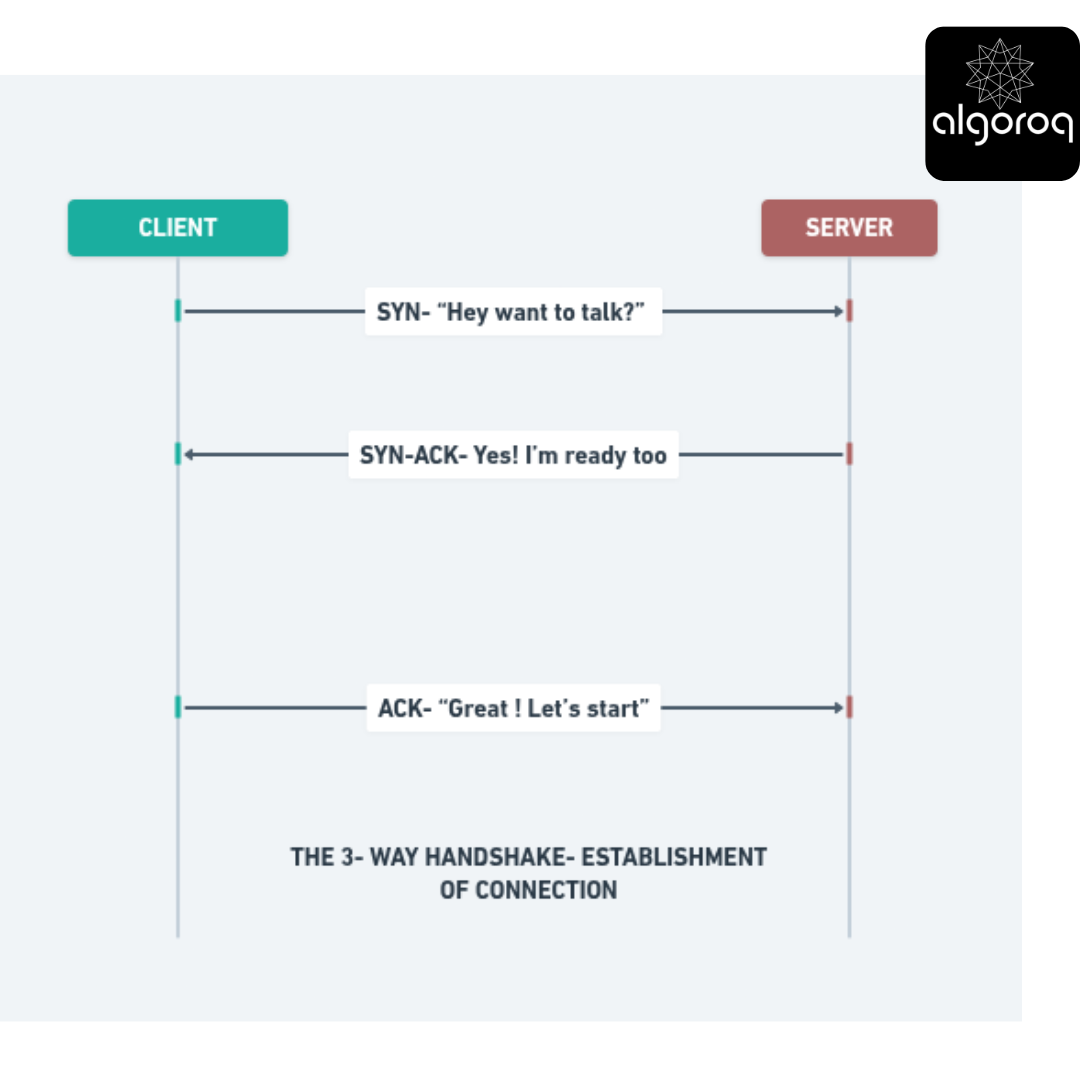
Real-world parallel: The 3-way handshake is like politely confirming both people are ready before starting a conversation. No one wants to talk to someone who isn't listening!
Key terms decoded:
- SYN (Synchronize) = "I want to connect"
- ACK (Acknowledge) = "I received your message"
- SYN-ACK = "I want to connect too, and I got your request"
🚨 Common Misconception: "Lost Packets Doom Your Connection... Right?"
You might worry: "If the internet is so chaotic and packets get lost all the time, how does anything work?"
The TCP safety net: TCP is like a delivery service with package tracking and automatic reshipment!
Here's what happens when a packet is lost:
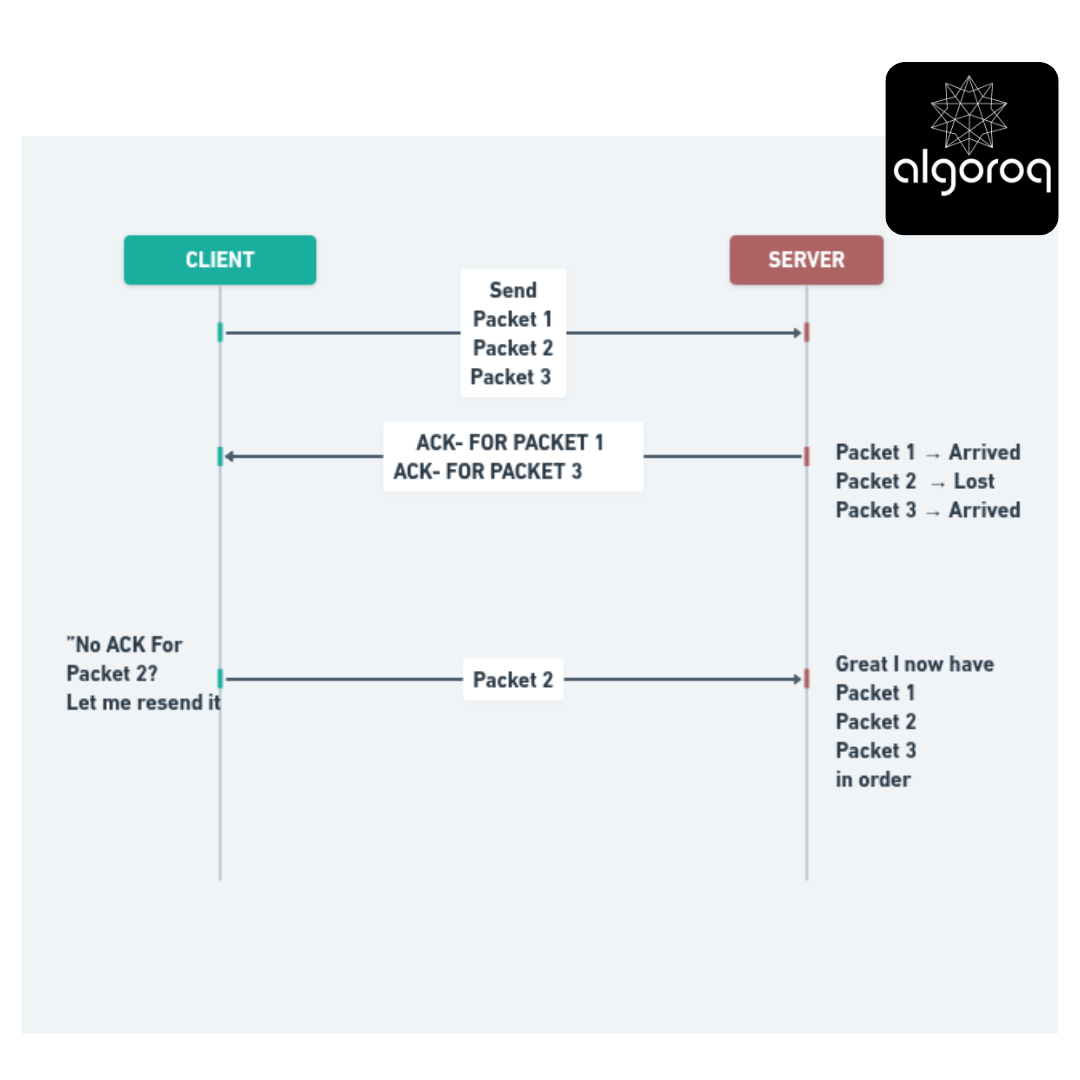
Mental model: If Amazon loses your package, they track it, realize it's missing, and automatically send a replacement. TCP does this automatically for every single packet!
Challenge question: What mechanism tells the sender a packet was lost? (Hint: Think about acknowledgments and timeouts)
🎮 Decision Game: Which Statement is True?
Context: A packet gets lost in the network during a TCP connection.
What happens next?
A. The packet is discarded, and the connection continues without it B. TCP waits indefinitely for the packet to magically reappear C. The sender detects the loss and retransmits the packet D. The receiver continues and leaves a gap in the data
Think about it... What would ensure reliable delivery?
Answer: C - The sender retransmits the packet!
Here's how TCP detects loss:
Method 1: Timeout
- Sender sends Packet 5
- Starts a timer
- No ACK received before timeout? → Resend Packet 5
Method 2: Duplicate ACKs
- Receiver keeps getting Packets 6, 7, 8 but no Packet 5
- Sends "Still waiting for Packet 5" multiple times
- Sender sees repeated ACKs → "Oops! Resend Packet 5 immediately"
Real-world parallel: When tracking your package:
- Timeout = "It should've arrived by now, let's resend"
- Duplicate ACKs = "The customer keeps calling saying it never arrived, send another now!"
🚰 Problem-Solving Exercise: The Water Pipe Problem
Scenario: You're transferring data to a server. Your connection can send 100 Mbps, but the server can only process 10 Mbps.
What do you think happens?
- The server crashes from overload?
- Data gets lost because the server can't keep up?
- The connection automatically adjusts to the slower speed?
Solution: Flow Control!
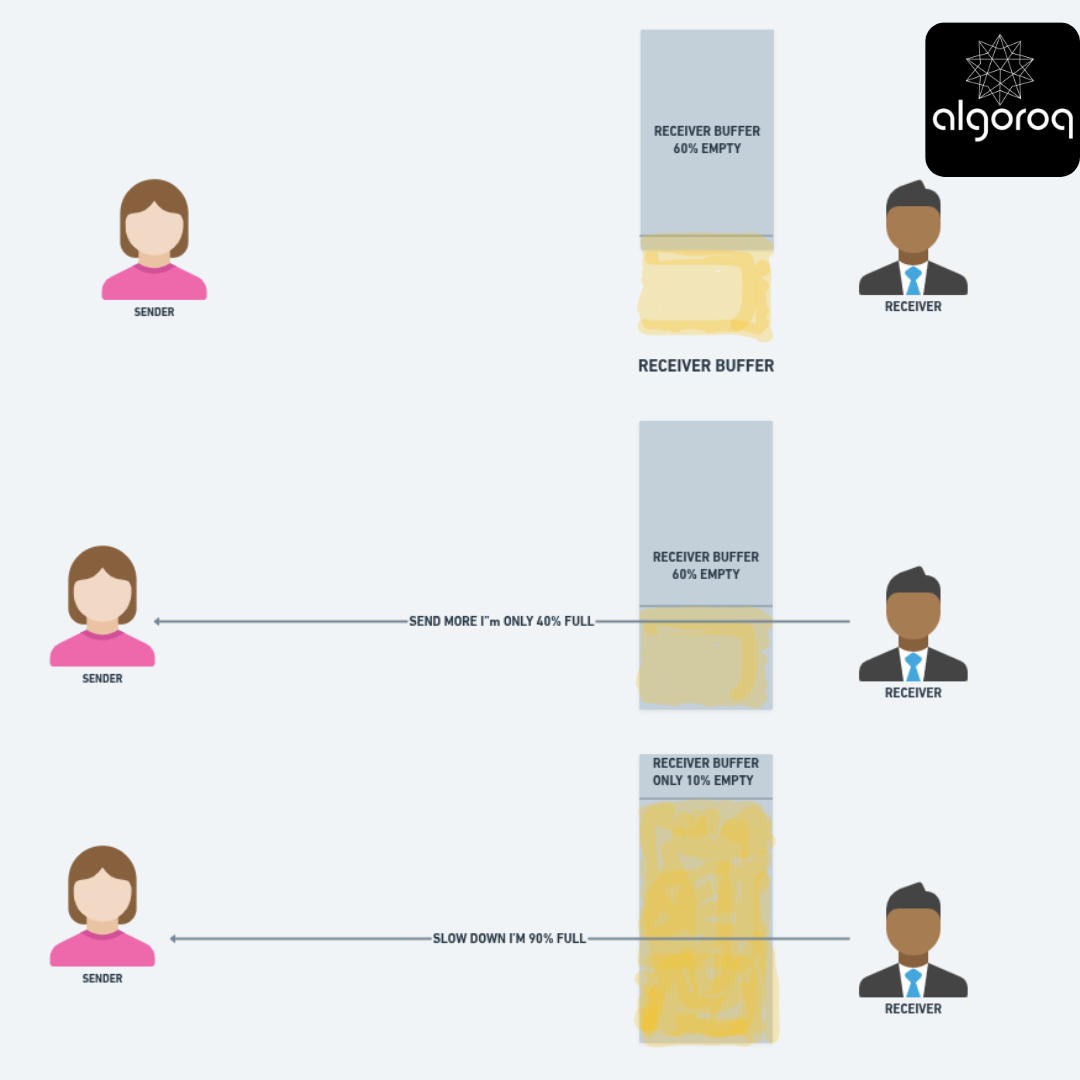
TCP has a sliding window mechanism - think of it as a smart water pipe with adjustable pressure:
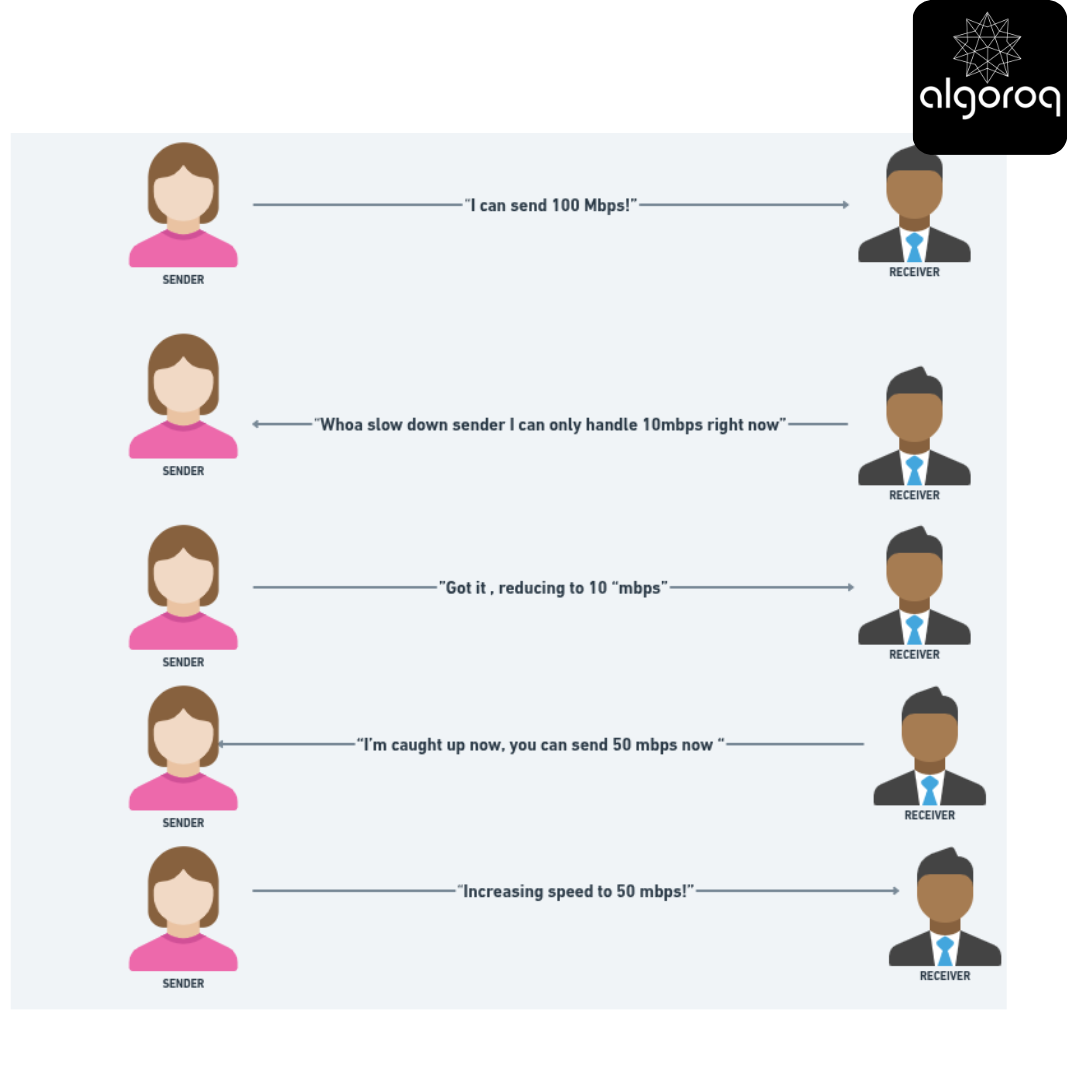
Real-world parallel: Flow control is like traffic lights on a freeway on-ramp. When traffic is heavy, the light slows down cars entering. When it clears up, cars enter faster. This prevents highway congestion!
The mechanism:
- Receiver advertises a receive window size: "I have buffer space for X bytes"
- Sender never sends more than that amount
- Window size adjusts dynamically
🔍 Investigation: The Restaurant Order Guarantee
Imagine ordering food online:
Step 1: You place an order
Step 2: Restaurant confirms: "We got your order for pizza with extra cheese"
Step 3: You receive: Pizza with mushrooms (wrong!)
What would you do? You'd call them: "This isn't what I ordered! Check your notes!"
TCP's Error Detection: Checksums
TCP does exactly this for every packet:
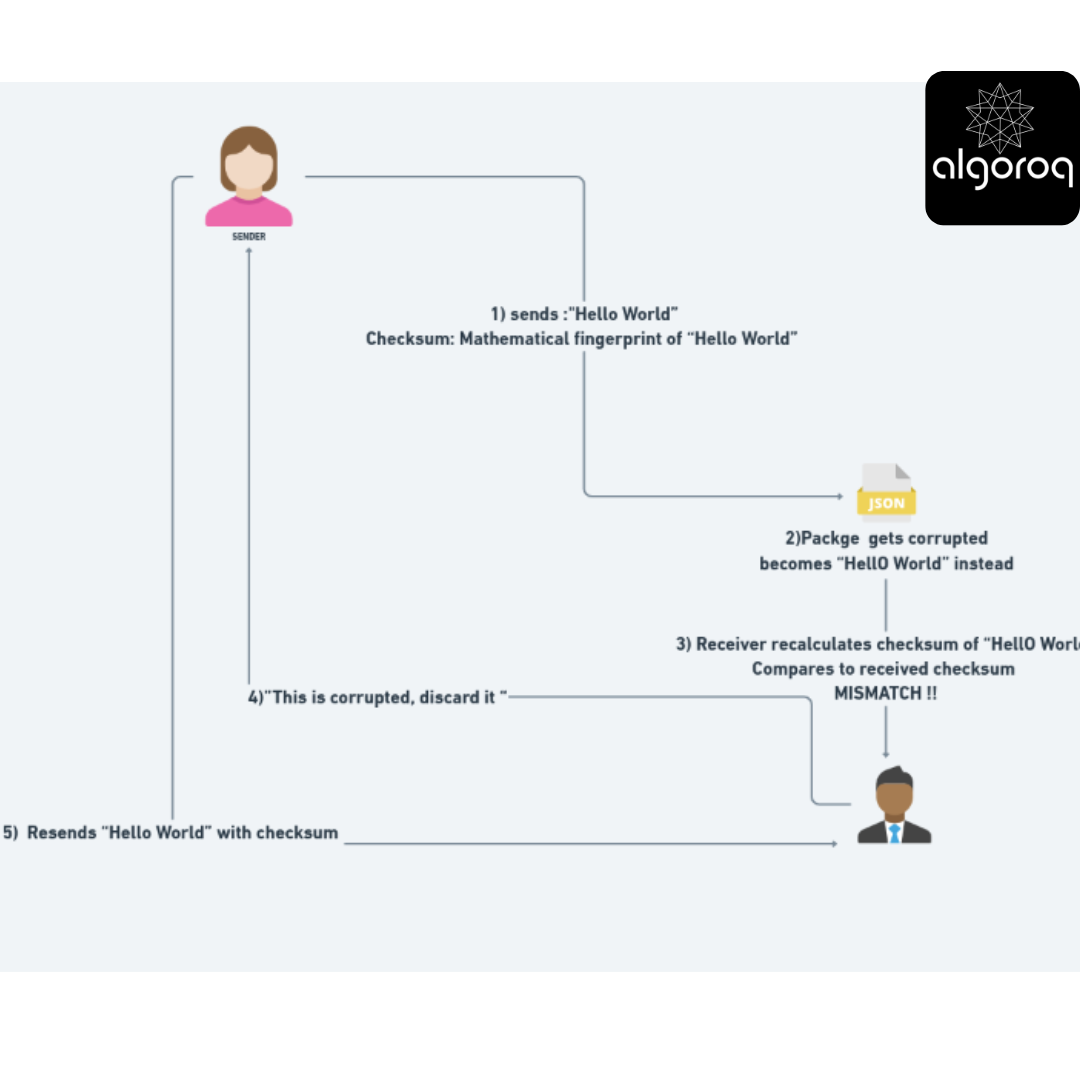
Mental model: The checksum is like a verification code on your restaurant order. If the food doesn't match the code, you know something went wrong!
Key insight: TCP catches errors that IP doesn't even check for. Every packet is verified before acceptance.
🧩 Sequencing Challenge: The Shuffled Delivery
Scenario: You order 5 books online (numbered 1-5). Due to different warehouses and shipping routes, they arrive in this order:
📦 Book 3 (arrives first)
📦 Book 1 (arrives second)
📦 Book 5 (arrives third)
📦 Book 2 (arrives fourth)
📦 Book 4 (arrives last)
Question: How do you arrange them in the correct order on your shelf?
Think about it: You'd look at the book numbers, right?
TCP Sequence Numbers: Sorting the Chaos
TCP attaches sequence numbers to every packet:
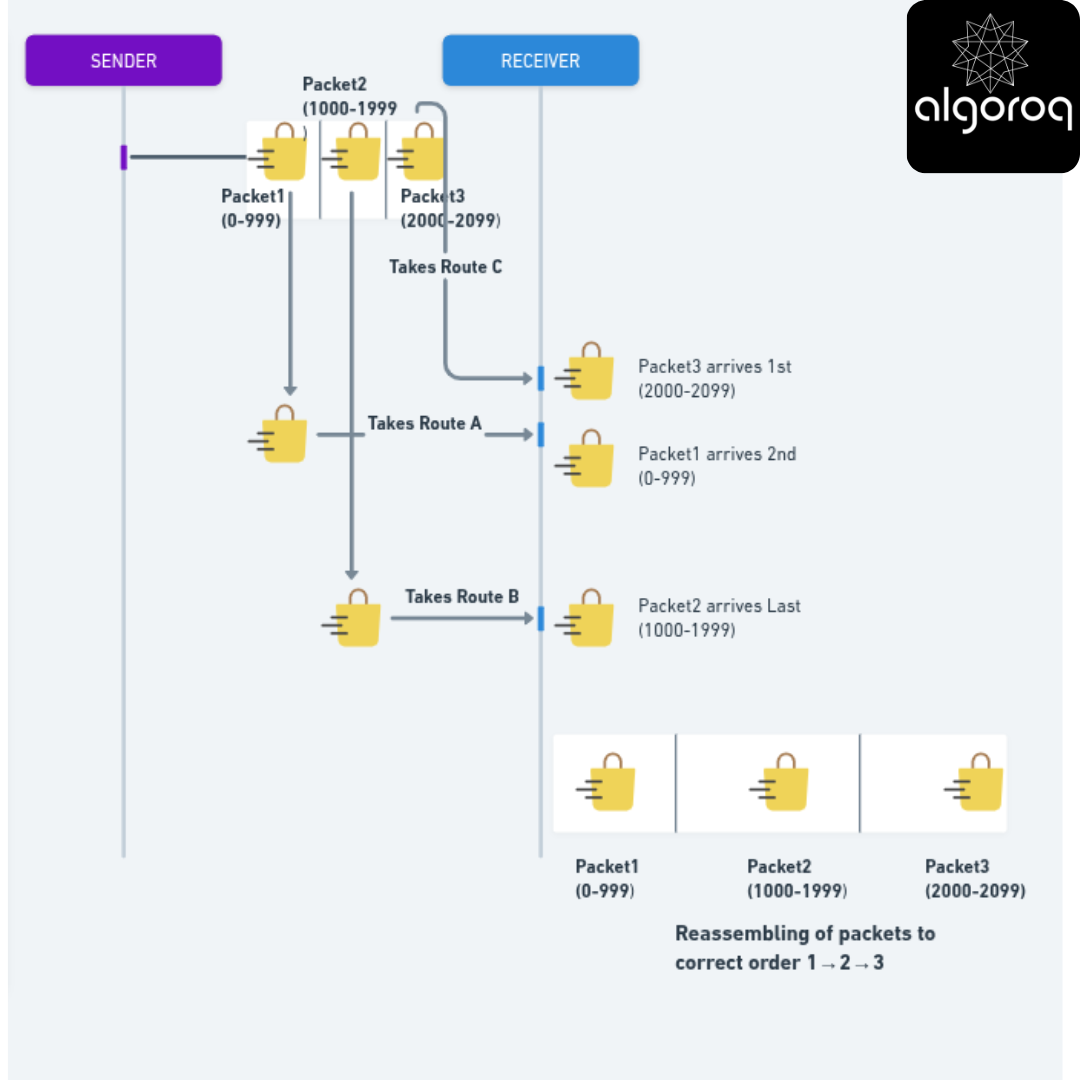
Real-world parallel: Like numbered pages in a book. Even if they arrive mixed up, you can always reassemble them in the correct order!
This is why your video streams and downloads work perfectly even though packets take chaotic routes across the internet!
👋 Interactive Journey: The Polite Goodbye
Scenario: You've finished a great conversation with a friend. Do you:
A. Just walk away silently mid-sentence? B. Say "Bye!" and make sure they heard you before leaving?
Obviously B, right? TCP thinks so too!
The 4-Way Handshake: Graceful Connection Termination
Unlike abruptly hanging up, TCP ensures both sides agree the conversation is over:
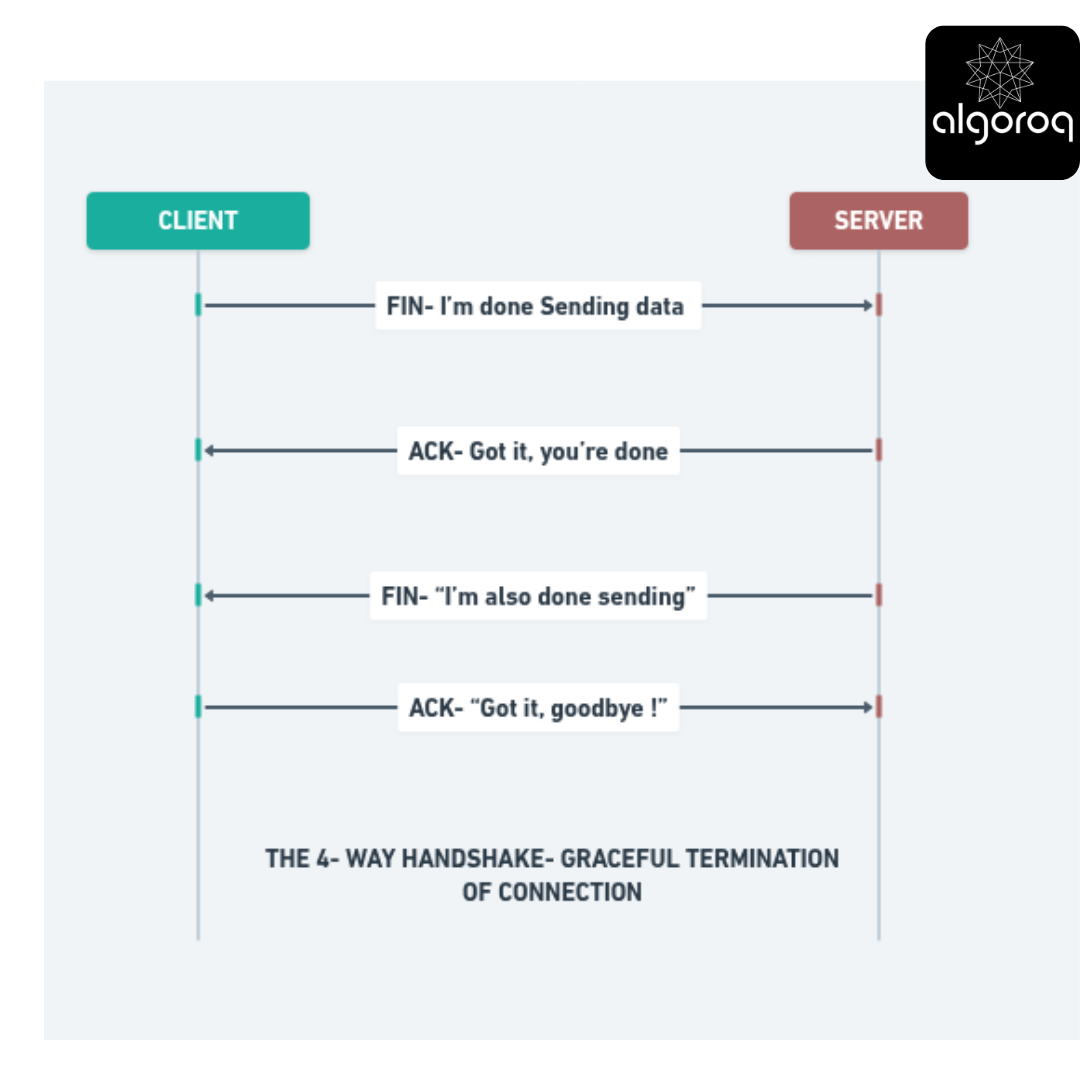
Why 4 steps instead of 2?
Because TCP is full-duplex (data flows both ways simultaneously):
- Client says: "I'm done sending" (but can still receive)
- Server says: "I'm done sending too" (but might still be processing)
- Both confirm: "Okay, truly done now"
Mental model: It's like ending a phone call:
- You: "Okay, I have to go"
- Friend: "Okay, understood"
- Friend: "I also need to go"
- You: "Bye!" → Click
Both people confirm the conversation is completely finished.
Challenge question: When does the 4-way handshake happen?
- At connection start? NO - that's the 3-way handshake
- During data transfer? NO - that's normal operation
- At connection termination? YES! ✓
🎪 The Great Comparison: TCP vs Real-World Services
Let's solidify your understanding. Match TCP's features to real-world services:
TCP Feature → Real-World Equivalent
- 3-way handshake → ?
- Acknowledgments → ?
- Sequence numbers → ?
- Flow control → ?
- Retransmission → ?
- 4-way handshake → ?
Think about each one...
Answers revealed:
- 3-way handshake → 📞 Knocking before entering, making eye contact before talking
- Acknowledgments → ✅ Delivery confirmations, read receipts on messages
- Sequence numbers → 🔢 Page numbers in a book, numbered tickets at the deli
- Flow control → 🚦 Traffic lights controlling freeway on-ramps
- Retransmission → 📦 Amazon resending lost packages automatically
- 4-way handshake → 👋 Polite phone call ending: "Bye" "Bye" "Okay" "Okay goodbye"
The big picture: TCP makes the chaotic internet feel like a reliable, ordered, confirmed delivery service - even though underneath it's built on unreliable IP!
💡 Final Synthesis Challenge: The Postal Service Analogy
Complete this comparison:
"IP is like dropping letters in a mailbox with no tracking, no guarantee of delivery, and no order promised. TCP is like..."
Your answer should include:
- How reliability is achieved
- How ordering is guaranteed
- How errors are handled
- How connections are managed
Take a moment to formulate your complete answer...
The Complete Picture:
TCP is like a premium courier service that:
✅ Requires appointment (3-way handshake) before delivery starts
✅ Tracks every package with sequence numbers
✅ Confirms delivery with acknowledgment signatures
✅ Automatically resends any lost packages (retransmission)
✅ Verifies contents match what was sent (checksums)
✅ Adjusts delivery speed based on your receiving capacity (flow control)
✅ Ensures correct order even if packages take different routes
✅ Politely confirms when service is complete (4-way handshake)
This is why:
- Your file downloads are complete and uncorrupted
- Your video calls remain synchronized
- Your web pages load all images correctly
- Your emails arrive with all attachments intact
TCP transforms the chaos of IP into reliability you can depend on!
🎯 Quick Recap: Test Your Understanding
Without looking back, can you explain:
- Why does TCP use a 3-way handshake instead of just sending data immediately?
- What happens when a packet is lost?
- How does TCP maintain correct order when packets arrive scrambled?
- Why does closing a connection need 4 steps instead of just 1?
Mental check: If you can answer these clearly, you've mastered TCP fundamentals! If not, revisit the relevant sections above.
🚀 Your Next Learning Adventure
Now that you understand TCP, you're ready to explore:
Immediate comparisons:
- UDP (User Datagram Protocol): What if you don't need reliability? (Think: live streaming, online gaming)
- TCP vs UDP: When to use which? (The speed vs reliability tradeoff)
Explore Advanced TCP topics:
- Congestion Control: How does TCP avoid overwhelming the network? (TCP Reno, TCP Cubic algorithms)
- TCP Fast Retransmit: How does TCP detect loss faster than waiting for timeouts?
- Nagle's Algorithm: How does TCP efficiently bundle small packets?
Real-world applications:
- HTTP/HTTPS: How web browsing uses TCP
- SSH/SFTP: How secure remote access relies on TCP
- Email (SMTP): Why email needs TCP's reliability
Key Takeaways
- TCP provides reliable, ordered, error-checked delivery — the three-way handshake (SYN, SYN-ACK, ACK) establishes a connection before data flows
- TCP handles retransmission automatically — lost packets are detected via acknowledgments and re-sent with exponential backoff
- Flow control prevents senders from overwhelming receivers — the sliding window adjusts based on the receiver's buffer capacity
- Congestion control prevents network overload — algorithms like slow start and congestion avoidance adapt to network conditions
- TCP's reliability comes at a cost — the handshake, acknowledgments, and retransmissions add latency compared to UDP
Log in to keep reading
Create a free account to keep reading and track your progress.
Log in — it's free